This section is under construction. If interested in details - please email me!
I am interested in developing a topological theory of ontogenesis, looking at the concrete spatial organization of organisms and at the topology of the abstract configuration space from which their structure arises. I am very disillusioned with the cybernetic / circuit approach, and driven to look for a characterization of the intensive qualities (in the thermodynamic sense) that make living things, understanding that the extensive measurements are almost always a tangled, combinatorial effect cycling with these inherent qualities. Embryonic development, a canonical, reproducible process of intractable dynamic instability, including plasticity and a blurring of the relation between unit and multiplicity, embodied an attractive though complex case study for this endeavor.
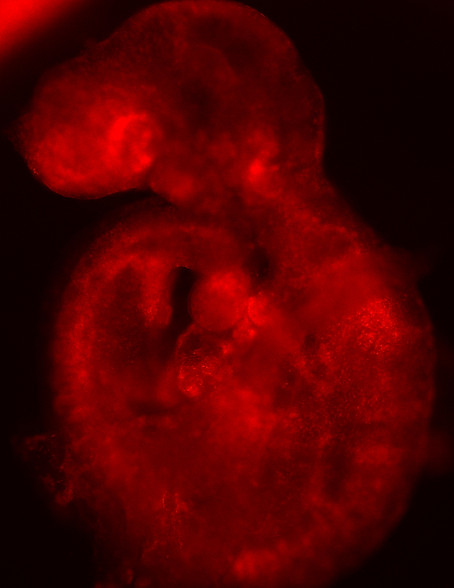
During my masters, I worked on applying a molecular method to reconstruct cell lineage trees in mouse embryo gastrulation, taking into account the inherent plasticity of the process. The lab had already constructed a time resolved transcriptional atlas using some strong parsimony assumptions. My project was set to prove that inferred coalescent structure coupled with measurements of cell states could detect convergence events in the differentiation flow upon this transcriptional landscape, endowing us with a method to challenge the widely accepted view of differentiation as recapitulating a bifurcating tree structure point-wise.
My thesis project consisted of building algorithms to model and simulate embryonic development, bringing a proof of concept for defining differentiation trajectories from phylogenetic data, developing a custom pipeline to process scRNA-seq data and reconstruct cell phylogenies, as well as culturing mESCs and preparing sequencing libraries.
To me, the very motion of differentiating space by a fold of the inner from the outer and defining a dynamic selectivity between these zones, present even in the simple unicellular organism, is the first gesture of living. I believe that non-trivial topologies (again, both in configuration and "natural" space) go hand in hand with plasticity and may be an interesting axis upon which to wind evolution. I would like to study the way not only that homologous structures relate or differ but also view their articulation with each other, the chain of interiorities they define as an evolutionary feature across all scales.
Acknowledgments
Regenerative base editing enables deep lineage recording
Duncan Chadly, Ron Hadas, Leslie Klock, Jiahe Yue, Felix Horns, Amjad Askary, Alejandro Granados, Remco Bouckaert, Carlos Lois, Long Cai, Michael B. Elowitz; BioRxiv, 2026
A quantitative model for spatio-temporal dynamics of root gravitropism
Amir Porat, Mathieu Rivière, Yasmine Meroz; Journal of Experimental Botany, 2024


